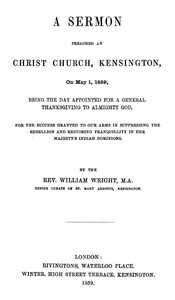
A Sermon preached at Christ Church, Kensington, on May 1, 1859 being the day appointed for a general thanksgiving to Almighty God, for the success granted to our arms in suppressing the rebel
Edition facts
William Wright's 1859 sermon, preached on a national thanksgiving day for the suppression of the Indian Rebellion, opens with a bold typological move: he aligns Queen Victoria and the British legislature with King David, whom God preserved and blessed. Wright insists that a Christian nation, baptized and educated in the Gospel, stands under the same divine guardianship as David. This equation is not merely ceremonial; it underpins the sermon's entire argument that Britain's military success imposes a sacred duty to evangelize India. The preacher's diction is deliberately elevated, weaving scriptural quotation with political theology, and his sentences often build through parallel clauses and rhetorical questions, as when he asks his congregation to contrast 'the greatness of the work to be accomplished with the contemptibly limited means.'
Typology and National Identity
Wright's central rhetorical device is typology: he reads the Old Testament narrative of David as a direct pattern for Victorian Britain. The sermon's text, 2 Samuel viii.14-15, describes David's garrisons in Edom and his reign of 'judgment and justice.' Wright argues that if God protected David under the 'earlier revelation,' He will certainly protect a Christian queen and parliament. This move allows Wright to claim that Britain's government is 'essentially and generally Christian' despite acknowledged 'Judaism, vice, and infidelity' within it. The preacher does not shy from the tension; he acknowledges imperfections but insists they do not 'interfere with our present argument.' The typology is not merely analogical but providential: the rebellion's suppression is framed as divine vindication, and the 'violence of circumstances' is described as 'emissaries of the great Creator's purpose.'
Rhetorical Structure and Audience
Wright's sermon is carefully structured to move from assertion to exhortation. He begins with a logical claim about divine protection, then shifts to prayer, quoting the collect for Parliament. The middle sections build emotional intensity through a series of rhetorical questions: 'Who is there amongst us that does not now desire to enter in? Who does not burn with indignation at his own—his country's—missionary apathy?' These questions crescendo into a direct challenge to the congregation, using imperative verbs: 'Plant amongst them a church. Erect for them a school. Provide them with a minister.' The preacher's voice is authoritative yet urgent, and he frequently addresses his hearers as 'my beloved brethren,' creating a pastoral intimacy that contrasts with the grand political themes. The sermon's length—around 6,800 words—suggests a formal, literate audience accustomed to extended theological reasoning.
Diction and Imagery of Spiritual Warfare
Wright's language consistently blends military and missionary imagery. The rebellion is 'suppressed,' tranquillity 'restored,' and the gates of superstition 'torn from their hinges.' But the preacher immediately redirects this martial energy: he tells his congregation that they should 'wield the sword of the Spirit' rather than 'brandishing over their heads the cold and deadly steel.' The most striking image is that of India as 'a vast sea of souls, now surging with infidelity, now again raging with superstition,' bearing 'but few, very few, labourers in the employ of that blessed and acceptable merchandize.' The metaphor of fishing for souls is traditional, but Wright gives it a commercial twist with 'merchandize,' and he contrasts the 'contemptibly limited means' of one pastor per million souls with the scale of the task. His diction is often concrete: 'plant,' 'erect,' 'provide,' 'fight,' 'tell,' 'show.'
The Missionary Imperative as National Duty
Wright's sermon culminates in a call to action that is both spiritual and practical. He insists that the Gospel 'has made us great, and caused us to shine like lights in the world,' and that Britain must pass it on to India. The preacher frames missionary work as a natural outflow of faith: 'Each true believer is, by his very impulse of faith, a soul-seeking power amongst men.' He describes the missionary germ as 'only requiring the light and heat of a living faith to raise and mature it.' The sermon ends with a direct appeal to the congregation to accept 'this, this for all we know last, last challenge' to visit India 'gospel in hand.' Wright's repetition of 'last' underscores urgency, and his final vision is of eternal joy: 'rejoice for ever and ever in heaven that they were preserved with you and yours unto everlasting life.' The closing thus ties national duty to personal salvation.
Readers approaching this sermon should attend to how Wright negotiates the relationship between Old Testament typology and contemporary politics. His argument depends on a specific reading of scripture as directly applicable to national events, and his rhetorical questions reveal the emotional pressure he applies to his congregation. The sermon is a valuable document of mid-Victorian Anglican thought, showing how a preacher could blend thanksgiving, theology, and a call to imperial mission without ever losing sight of his biblical text.