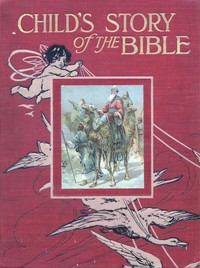
Child's Story of the Bible
Edition facts
Mary A. Lathbury's Child's Story of the Bible (1898) is a retelling designed for mothers to use in the home, as she states in her preface: 'I have been asked to prepare this little aid for your use in the Home—that first and greatest of schools.' The book is notable for its deliberate fidelity to the Authorized Version in quoted speech—'in all quoted speech I have used the exact words of the authorized version'—while the surrounding narrative employs simple, concrete description. For example, when Joseph and Mary enter the Temple, Lathbury writes of 'the white steps of the beautiful porch' and 'long rows of marble pillars,' grounding the sacred story in sensory detail.
A Mother's Textbook and the Author's Stated Method
Lathbury's preface directly addresses mothers, positioning them as 'the earliest and most important teachers' in a school 'founded by the Maker of men.' She explicitly limits her own invention: 'I have tried to preserve the pure outlines of the sacred record from the vivid description and the suggestive supposition that are sometimes introduced to add charm to the story.' This restraint is a key authorial choice. The introduction, by Bishop John H. Vincent, reinforces the domestic scene: 'When the children gather at mother's knee, and the tiniest finds a place in mother's arms, and all clamor for a “story,” “a story, mamma,” how lovely is the picture.' Together, these framing texts reveal that the book is not merely a Bible story collection but a pedagogical tool, with the mother as the intended mediator.
Exact Words and Narrative Embellishment
Lathbury's policy of using 'the exact words of the authorized version' for quoted speech creates a distinctive texture. In the excerpt, Simeon's words—'Lord, now lettest Thou thy servant depart in peace, according to Thy word, for mine eyes have seen Thy salvation'—are given verbatim. Yet the surrounding narrative is freely descriptive: the Magi ride camels with 'beautiful saddles covered with blue and crimson cloth,' and they 'watched it from their tents on the sand.' This blend of scriptural quotation and invented detail allows Lathbury to remain faithful to the text while making scenes accessible to children. The result is a work that oscillates between the stately rhythm of the King James Bible and the homely clarity of a mother's voice.
Sensory and Spatial Details in the Temple Scene
Lathbury's description of the Temple in the presentation of Jesus is rich with spatial and sensory cues: 'the white steps of the beautiful porch,' 'the long rows of marble pillars,' 'the court of the Gentiles,' and the Temple itself with 'its white marble pillars and golden roof shining in the sun.' She distinguishes the Court of the Women from the Men's Court, noting that Mary gave her doves 'at the gate of the Court of the Women' while Joseph took the child 'into the Men's Court for the Priest to bless.' This attention to architectural detail serves both to educate young readers about the Temple's layout and to create a vivid mental picture. The phrase 'shining in the sun' adds a visual brightness that recurs in the Star narrative.
The Wise Men and the Motif of Light
The story of the Magi introduces a sustained motif of light and guidance. The Star is described as 'strange and beautiful,' 'shining before them low in the sky,' and they 'watched it from their tents on the sand.' Lathbury emphasizes the contrast between the desert's 'yellow sand' and the 'fresh green mountain country' of Judea, as well as the disappointment of finding no celebration in Jerusalem. The Magi's journey is rendered in concrete terms: 'Their servants loaded the camels with food and water and some costly gifts,' and they rode 'on beautiful saddles covered with blue and crimson cloth.' These details, while invented, serve to make the exotic travelers relatable. The Star itself becomes a character, leading and reassuring the travelers through the night.
Readers approaching Child's Story of the Bible will find a work that balances scriptural fidelity with imaginative expansion. Lathbury's method—quoting the Authorized Version exactly while adding descriptive context—creates a distinctive voice that is both reverent and accessible. The book is best understood as a mother's aid, not a standalone text, and its value lies in the interplay between the sacred words and the homely details that bring them within a child's grasp.