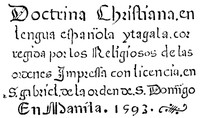
Doctrina Christiana The first book printed in the Philippines, Manila, 1593.
Edition facts
The 1593 Doctrina Christiana is not a catechism in the usual sense; it is a bibliographic artifact whose survival is a minor miracle. Edwin Wolf's introductory essay frames the book as the quarry of a four-century hunt, with scholars piecing together clues from archives across Europe and the Americas. The volume itself—a block book printed on paper made from mulberry bark, with a woodcut of St. Dominic showing Chinese stylistic influence—embodies the cultural intersections of early colonial Manila.
Physical Evidence and Oriental Craftsmanship
The woodcut of St. Dominic, Wolf notes, is of oriental workmanship, with clouds that are characteristically Chinese and buildings more reminiscent of eastern temples than European churches. This observation ties the book's production to local artisans, not merely Spanish missionaries. The paper, made from the mulberry species Broussonetia papyrifera, follows Chinese papermaking traditions, as described by Dard Hunter. Wolf also details the use of gypsum, lichen, and starch for sizing—techniques imported from China. These physical details, drawn from the facsimile and contemporary scholarship, ground the book in a specific material culture that the catalog subject 'Block books — Facsimiles' only hints at.
The Documentary Trail and Bibliographic Debate
Wolf reconstructs the hunt for the Doctrina through letters, royal decrees, and archival finds. A key piece is a 1593 manuscript summary of writings in the Philippines, quoted by Retana and Artigas, which mentions the book. Another is a letter from Governor Gómez Pérez Dasmariñas, discovered in the Archives of the Indies by Gayangos and first printed by Retana in 1894. Wolf weighs testimonies that challenge the Doctrina's primacy, such as claims for earlier Mexican or Chinese imprints, but concludes that the evidence—including the 1593 date and the absence of earlier Philippine imprints—supports its status as the first. The essay's method is forensic, treating each document as a clue in a 'bookish detective story.'
Language, Audience, and Colonial Context
The Doctrina contains text in Spanish and Tagalog, the latter rendered in both Latin script and Baybayin, the indigenous syllabary. Wolf cites T.H. Pardo de Tavera's classification of Tagalog as part of the Malayo-Polynesian family. The bilingual format reflects the catechism's dual audience: Spanish clergy and native converts. Yet the catalog subjects list 'Tagalog language — Texts' and 'Catholic Church — Catechisms — Tagalog' without noting the Spanish component or the visual layout. Wolf's essay, by contrast, emphasizes the book's role as a tool of evangelization in a colony where inflation and supply shortages (noted in Bishop Salazar's 1583 report) made printing a practical necessity. The facsimile itself, reproduced in full, allows readers to see how text and image worked together.
Wolf's essay is best read alongside the facsimile plates, which reveal the material details he describes—the Chinese-style clouds, the Baybayin script, the paper texture. The book is not a standalone text but a window into early global print culture, where Chinese paper, Spanish doctrine, and Tagalog speech converged. Readers interested in the detective work of provenance will find Wolf's footnotes a trail worth following.