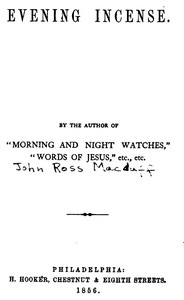
Evening Incense
Edition facts
John R. Macduff's Evening Incense (1856) is structured as a sequence of thirty-one evening prayers, each keyed to a distinct spiritual need—from 'Communion with God' to 'Meeting in Heaven.' The title and epigraph draw on Exodus 30:1–8, where Aaron burns incense at evening before the mercy-seat, a metaphor Macduff sustains throughout: each prayer is framed as an 'evening oblation' rising from a 'Golden Altar.' The prayers follow a consistent pattern: an address to God, a scriptural prompt (usually a verse), a petition for grace, intercession for the church and the world, and a closing plea for protection through the night. This liturgical regularity gives the volume a meditative, unhurried rhythm, yet the language shifts in intensity as the petitions move from confession to aspiration.
A Fixed Liturgical Architecture
Every prayer in Evening Incense adheres to a nearly identical structure: an opening invocation ('O God, I desire to approach Thy throne of Grace'), a scriptural anchor (e.g., Luke 24:29 in the first evening), a central petition for a specific grace, a brief intercession for the church and the world, and a closing request for nightly protection. This repetition is not a flaw but a deliberate devotional aid, allowing the reader to settle into a familiar rhythm. The headings—'For Pardoning Grace,' 'For Renewing Grace,' 'For Sanctifying Grace'—function as a taxonomy of spiritual needs, each prayer isolating one facet of the Christian life. The effect is cumulative: the same phrases recur ('blessed Jesus,' 'Throne of Grace,' 'for Jesus' sake'), yet the focus shifts subtly, creating a sense of incremental spiritual progress across the thirty-one days.
The Voice of Creature-Destitution
Macduff's narrator consistently adopts a posture of utter dependence. Phrases like 'deep creature-destitution,' 'bringing nothing in my hands,' and 'my best actions are marred with defilement' recur across the excerpts, establishing a voice that is self-accusing yet hopeful. The nineteenth evening, 'For Renunciation of Self,' intensifies this: the speaker pleads to be shown 'the plague of my own heart' and to be led 'through the valley of humiliation.' This is not generic humility but a specific theological stance—a conviction that human sufficiency is nil ('our sufficiency is of God,' from 2 Cor. 3:5). The language of 'clinging to no remnants of my own self-righteousness' and 'alienating existence from its great end' gives the prayers a sharp, introspective edge, distinguishing them from mere comfort.
Shifts in Pace: From Petition to Intercession
Within each prayer, Macduff modulates pace by moving from personal petition to broader intercession. In the first evening, after asking for communion and protection, the prayer suddenly widens: 'Have mercy on a world lying in wickedness! Pity the careless; arouse the slumbering; support the weak; succour the poor.' The rhythm quickens through a series of imperative verbs—'Pity,' 'arouse,' 'support,' 'succour'—before contracting again to the personal: 'Take the charge of me and of all near and dear to me this night.' This expansion and contraction creates a breathing pattern, alternating between the intimate and the global. The nineteenth evening follows the same arc: after a long meditation on self-renunciation, it pivots to 'May the Lord have mercy upon Zion. May showers of blessing descend on Thy holy hill.' The effect is to place the individual's nightly prayer within a cosmic frame.
Readers approaching Evening Incense will find it best used as a daily companion rather than a continuous narrative. The uniformity of structure rewards slow, reflective reading: each prayer can be lingered over, its scriptural allusion traced, its petition personalized. Macduff's voice is consistent but not monotonous—the shifts in emphasis from grace to grace invite the reader to attend to their own spiritual state. The book's brevity (thirty-one prayers, each about 700 words) makes it manageable for a month's cycle, and the recurring imagery of incense, altar, and evening sacrifice provides a unifying sensory thread.