
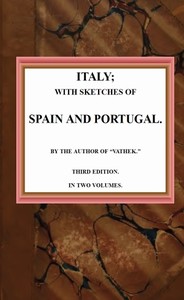
Italy; with sketches of Spain and Portugal by William Beckford
William Beckford's Italy; with sketches of Spain and Portugal is a collection of travel letters, but forget any notion of a simple guidebook. Written between 1780 and 1788, these are the vivid, personal dispatches of a young man in motion. Beckford, already famous (and infamous) for his Gothic novel Vathek, was traveling partly to cultivate his artistic tastes and partly to distance himself from English society gossip.
The Story
There isn't a plot in the traditional sense. Instead, Beckford acts as your wildly perceptive and sometimes melodramatic guide. He takes you from the classical ruins and art-filled galleries of Italy to the stark, passionate landscapes of Spain and Portugal. You'll stand with him in the Sistine Chapel, feel the chaos of a Lisbon street festival, and shudder at the intense pageantry of a Spanish religious procession. The 'story' is the journey itself—a sensory tour of 18th-century Europe, filtered through one man's extravagant imagination. He’s less interested in listing facts and more in capturing the feeling of a place, whether it's awe, melancholy, or delight.
Why You Should Read It
You read this for Beckford's voice. It's intimate, like reading someone's brilliantly written diary. He doesn't just describe a view; he tells you how it made his soul ache. His observations are sharp, often funny, and surprisingly modern in their focus on emotion and atmosphere. While he marvels at the art and architecture, some of the best passages are about people—the peasants, the nobles, the monks. You get a double portrait: one of the countries he visits, and one of the complex, lonely man writing the letters. It’s a masterclass in personal observation.
Final Verdict
This book is perfect for readers who love history but want to experience it through a human lens, not a textbook. It's for the armchair traveler who appreciates beautiful, flowing prose and a strong authorial personality. If you enjoy the works of later travel writers like Patrick Leigh Fermor or Jan Morris, you'll find a fascinating ancestor in Beckford. Just be ready for some romantic flourishes—the man never used one adjective when three would do. A truly captivating escape into the past.
Nancy Flores
1 year agoSimply put, the flow of the text seems very fluid. Truly inspiring.




Patricia Gonzalez
1 year agoVery helpful, thanks.