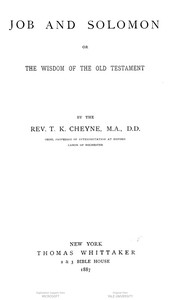
Job and Solomon: Or, The Wisdom of the Old Testament
Edition facts
Cheyne opens by stating that exegesis and criticism are equally necessary for enjoying the Old Testament's treasures, and that no commentary is complete without explaining critical controversies. He admits his volume is a fragmentary realization of a long-maturing plan, hindered by personal drawbacks like eye trouble. The Books of Job and Ecclesiastes receive more detailed treatment than Proverbs and Ecclesiasticus, the latter requiring more philology than he allowed. He hopes the Appendix is not unreadable, and notes that the canonicity of Ecclesiasticus is handled with Ecclesiastes.
The Role of the Wise Men
Cheyne argues that the 'wise men' were an integral part of Jewish national life long after Solomon. They gave independent support to prophets, whose peremptory style needed supplementing by the wise men's more conciliatory and individualizing manner. After the Babylonian Exile, wise men became predominantly writers on practical moral philosophy. Sirach exemplifies this shift: he describes himself as a gleaner after the vintage, collecting proverbs. Cheyne notes that Sirach's work likely contains older proverbs, but his special characteristic is arranging material by subjects—a progress in literary art.
Sirach's Debt to Proverbs
Cheyne provides multiple parallelisms between Sirach and Proverbs, showing Sirach's manifest indebtedness. For example, Sir. i. 4 parallels Prov. viii. 22; Sir. i. 14 parallels Prov. i. 4 and ix. 10; Sir. iv. 12-13 parallels Prov. iv. 7-8. Beyond Wisdom sayings, ordinary sayings also correspond: 'Better a mean man that tills for himself' (Prov. xii. 9) matches Sir. x. 27; 'A merry heart makes a cheerful face' (Prov. xv. 13) matches Sir. xiii. 25-26a. Cheyne emphasizes that Sirach delights in allusions rather than affecting originality.
Structure and Grouping in Ecclesiasticus
Cheyne highlights Sirach's thematic grouping, citing chap. xxii. 1-6 on good and bad children, 7-18 on the fool, 19-26 on friendship, and 27-xxiii. 6 on prayer and sins of the tongue. He notes that the plan is not thoroughly carried out, but even the attempt marks progress. Cheyne references Holtzmann in Bunsen's Bibelwerk for this observation. The grouping distinguishes Sirach from canonical predecessors, though his style shows night-and-day study of revered models.
Cheyne's Method and Limitations
Cheyne is candid about his volume being fragmentary. He intended to treat Proverbs more fully in an appendix but was interrupted. He refers readers to the forthcoming Variorum Bible for detailed notes on Proverbs. For Ecclesiasticus, he hopes to recast the section based on Bickell's and Edersheim's researches, offering it only as an illustrative sequel. The canonicity of Ecclesiasticus is handled with Ecclesiastes at the close of that part. Cheyne's approach is grounded in exegesis, not pure criticism.
Cheyne's work rewards readers who attend to his exegetical method and the specific parallels he draws. The volume is best approached as a series of linked studies rather than a comprehensive guide. Readers familiar with Proverbs will find the comparisons with Sirach especially illuminating, while those new to Wisdom literature may benefit from starting with the sections on Job and Ecclesiastes, which receive fuller treatment.