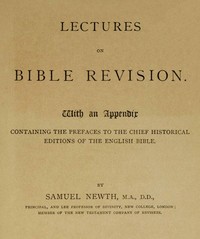
Lectures on Bible Revision
Edition facts
Samuel Newth addresses his Lectures on Bible Revision specifically to Sunday-school and Bible-class teachers, aiming to equip them with an intelligent position regarding the new revision of the English Scriptures. As a member of the New Testament Company of Revisers, Newth writes from inside the process, yet he explicitly states that his purpose is not to exhibit or justify the changes made. Instead, he provides a compendious survey of the general argument for revision and the facts that demonstrate the present duty of Christian men in relation to it.
A Compendious Survey for Teachers
Newth frames his work as a practical resource for those who cannot consult many books or read lengthened treatises. He directs attention to the chief stages in the growth of the English Bible, but only so far as needed to illustrate the main argument. The preface names Dr. Eadie, Dr. Moulton, Dr. Stoughton, and Dr. Westcott as authorities for further study, establishing a clear lineage of scholarship. Newth’s own voice is measured and pedagogical, emphasizing the importance of teachers being able to meet enquiries about the revision from those around them.
The Appendix as a Window to Translators
The appendix gathers prologues or prefaces to the chief historical editions of the English Bible, some of which are not easily accessible to ordinary readers. Newth argues that these texts allow readers to come into personal contact with the noble men whose self-denying labours produced the English Bible. He highlights that the prefaces reveal the spirit, aims, and methods of the translators, and show how deep love and reverence for the Bible can demand changes in its outward form for more faithful exhibition of the truth.
Voice and Structure in the Excerpted Passage
The excerpt from the appendix (likely from Tyndale’s prologue) displays a vigorous, homiletic voice that contrasts with Newth’s own measured prose. It distinguishes three types of persons—the justiciary, the sensual person, and the right Christian man—using parallel structures and vivid imagery: the sensual person is called “a voluptuous swine,” and human nature is compared to a serpent’s poison from conception. The passage’s rhythm and repetition (e.g., “consenteth to the law,” “justifieth God”) create a persuasive, almost sermonic tone, illustrating the kind of direct engagement Newth values in historical prefaces.
Newth’s lectures serve as a bridge between the technical work of revision and the practical needs of teachers. Readers interested in the textual history of the English Bible will find the appendix a valuable primary source collection. The book’s strength lies in its focused scope: it does not attempt to be a comprehensive history, but rather a concise argument for revision, grounded in the conviction that reverence for Scripture demands accuracy in its transmission.