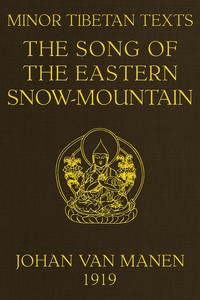
Minor Tibetan Texts: 1. The song of the Eastern Snow-mountain
Edition facts
Johan van Manen's edition of The Song of the Eastern Snow-Mountain is as much a document of Tibetan lexicography as it is a religious text. The prefatory note, citing Lewin, Jäschke, and Laufer, establishes a scholarly context of persistent difficulty: Tibetan idiom remained poorly documented, and existing dictionaries were deemed inadequate. Van Manen's response is a granular, almost obsessive commentary on individual words—their dictionary entries, variant spellings, and contextual meanings—that transforms the book into a case study in translation methodology.
Lexical Disputes and the Limits of Dictionaries
Van Manen repeatedly pits dictionary definitions against the testimony of his native informants. For the word drin, he notes that Jäschke equates it with drin, but his teachers object that it never occurs alone, requiring a final ba except in the superlative. The entry for gdung is even more revealing: Jäschke defines it as 'a song expressive of longing or of grief, an elegy,' but van Manen's dge rgan (teacher) insists the longing is religious, not worldly—a yearning for spiritual realities, not the memory of the three teachers mentioned in the poem. Van Manen leaves the question open, weighing 'paean' or 'hymn of praise' against 'lament.'
Such passages show the editor working at the boundary of available lexicons. He cites Sarat Chandra Das, Jäschke, and Desgodins, but finds them inconsistent: for gdug, Jäschke gives 'noxious, mischievous, dangerous,' Desgodins 'nuisible,' and Das 'vicious, mischievous, deleterious, poisonous.' Van Manen's own gloss—'malign, wicked, evil'—is a compromise, but he flags the disagreement rather than resolve it.
Grammatical Particles and the Texture of Tibetan
Van Manen devotes careful attention to enclitic particles and comparative forms. He argues that the chen or chen in many Tibetan adjectives is better regarded as an enclitic particle corresponding to the English suffix '-ful,' rather than meaning 'great' as a full word. He references Bell and Hannah on degrees of comparison, and notes that Jäschke's dictionary lists only 25 source texts—a figure that underscores the scarcity of reliable linguistic data.
The discussion of drang (to lead or pull) reveals the editor's interest in concrete imagery. The verb appears in a context involving a hook or goad; van Manen's teachers think of a rod with a hook like an episcopal staff, not angling or prodding. He suggests that pictorial representations might settle the point, but leaves the interpretation open. This reluctance to force a single meaning is characteristic of the entire work.
The Colophon as Interpretive Crux
The colophon of the song uses the word gdung, which van Manen treats as a key to the poem's genre. Jäschke's definition—'a song expressive of longing or of grief, an elegy'—is complicated by the teacher's explanation that the longing is religious, not personal. Van Manen hypothesizes that the poem might be a 'paean, hymn of praise, or psalm' rather than an elegy, but he does not settle on a single term. He even considers 'Weltschmerz' as a gloss, citing the German concept of world-weariness.
This section exemplifies van Manen's method: he presents multiple possibilities, weighs them against the text and against scholarly authority, and leaves the reader to judge. The colophon becomes a microcosm of the editorial challenge—how to render a culturally specific religious sentiment into English without distorting it.
Readers approaching The Song of the Eastern Snow-Mountain should be prepared for a text that is as much about the process of translation as about the song itself. Van Manen's notes reward those interested in the granular details of Tibetan grammar and lexicography, but the poem's religious and literary dimensions remain tantalizingly embedded in the philological apparatus. The work is best read as a collaborative effort between editor, informants, and earlier scholars—a dialogue about meaning that resists closure.