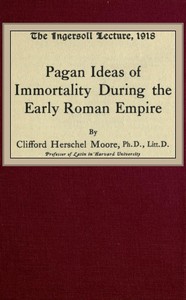
Pagan Ideas of Immortality During the Early Roman Empire
Edition facts
Moore opens his 1918 Ingersoll Lecture by situating pagan ideas of immortality within a period of religious longing and unrest, noting a widespread dissatisfaction with inherited forms of expression. He emphasizes that many felt a gulf between human and divine, hoping for direct revelation. The lecture draws on evidence from mystery cults, Pythagorean mysticism, and Neoplatonism, arguing that while belief in immortality grew, no new philosophical arguments were advanced beyond Plato's.
The Language of Initiation
Moore's description of mystery initiation is striking for its sensory and spatial vocabulary. He writes that the devotee 'had passed through the world of the dead and had been born again into a new life,' and 'had touched the elements—earth, air, water, and fire, the very foundations of the visible cosmos.' The phrasing emphasizes physical contact with cosmic fundamentals, not abstract belief. The vision of 'the sun which ever shines on the consecrated' suggests a permanent, radiant state. Moore's diction—'beatific vision,' 'salvation was secure forever'—borrows from Christian terminology, perhaps to highlight parallels or to make the pagan experience legible to his audience. The passage is careful to note that these words are 'obscure,' yet he extracts a clear sequence: death, rebirth, elemental contact, and eternal security.
Discipline and Degrees
Moore details the preparatory regimen for mystery devotees: 'lustral baths, fasting, abstinence, and penance.' This list of ascetic practices is followed by a structured religious career: 'degrees of initiation and grades of office marked his advance in faithful proficiency.' The language of hierarchy and progression—'degrees,' 'grades,' 'advance'—suggests a systematic, almost bureaucratic organization of religious experience. Moore also notes the use of 'magic words and formulae, committed to memory,' which assured safe passage to the afterlife. This emphasis on memorized text and ritual performance contrasts with the more intellectual mystic philosophies he later discusses. The passage implies that for many, immortality was secured not by argument but by correct procedure.
Rivalry with Christianity
Moore explicitly compares the oriental mysteries to Christianity, noting that they 'lost their hold in the Roman provinces before the growing power of Christianity; yet in the city of Rome they stubbornly held their ground until the end of the fourth century.' He offers a concrete spatial detail: 'The first St. Peter’s was built hard beside a shrine of the Great Mother of the Gods.' This juxtaposition of sacred sites—old and new—embodies the 'conscious rivalry' that lasted 'three-quarters of a century.' Moore's phrasing is measured: Cybele 'was forced to yield to Christ,' not triumphantly but as a historical outcome. The passage avoids triumphalism, instead presenting a gradual, contested transition.
Philosophy Without New Arguments
Moore argues that later mystic philosophies, including Neoplatonism, 'brought forward no new arguments' for immortality. Plotinus, he says, 'virtually repeats the proofs adduced by the founder of the Academy.' This claim is central to Moore's thesis: that the philosophical grounds for immortality were established once by Plato and merely reiterated. The lecture thus distinguishes between the emotional and ritual innovations of mystery cults and the intellectual stasis of philosophy. Moore notes that 'only in modern times have new arguments of any weight been adduced,' implying that the early Roman Empire was a period of consolidation, not discovery, in philosophical thought about the afterlife. This observation frames the lecture as a study of belief's persistence rather than its evolution.
Moore's lecture is best read as a historian's synthesis, not a philosophical treatise. He draws on literary and archaeological evidence—initiation formulas, temple sites, philosophical texts—to map a landscape of belief. Readers should attend to his careful distinctions between popular religion, mystery cults, and elite philosophy, and to his use of spatial and ritual language. The lecture rewards attention to how Moore frames continuity and change in religious thought.