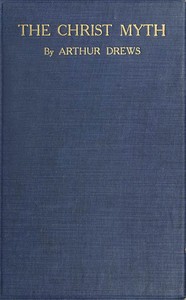
The Christ Myth
Edition facts
Arthur Drews opens The Christ Myth by situating his argument within a lineage of skeptical scholarship, citing David Friedrich Strauss, Bruno Bauer, and John M. Robertson as predecessors who doubted Jesus’s historicity. The preface immediately establishes a transnational network of critics—from Dupuis in France to Bolland in Holland—who traced Gospel narratives to astral myths and pious fictions. Drews does not merely summarize these figures; he uses them to frame his own central claim: that the figure of Jesus is a literary and mythological construct, not a historical person. The tone is combative, treating the question of historicity as unresolved and urgent, and the book as a continuation of a long-suppressed line of inquiry.
The Pauline Epistles as Second-Century Fabrications
Drews devotes considerable attention to the Pauline epistles, arguing that their authenticity cannot be established. He points to the silence of Luke, who accompanied Paul on missionary travels yet never mentions Paul’s literary activity, as a telling omission. Drews also cites the work of Smith, who claimed that the epistles were unknown before the mid-second century. For Drews, this gap undermines the traditional view of Paul as a historical figure writing to early churches. Instead, he suggests the epistles are products of a later school of theologians, written pseudonymously to lend authority to emerging Christian doctrines.
He contextualizes this practice within ancient literary culture, noting that works were often circulated under famous names—Orpheus, Pythagoras, Zoroaster—without any connection to the historical individuals. The Old Testament itself, he argues, contains pseudonymous writings: Psalms and Proverbs are not by David or Solomon; Daniel is a fictional persona. By analogy, the Pauline corpus could be a similar fabrication. Drews does not claim to prove this definitively, but he insists that the possibility cannot be dismissed, especially given the prevalence of “pious frauds” in the early Christian centuries.
The Silence of the Gospels and the Mythological Jesus
Drews builds his case by examining what the Pauline epistles actually reveal about Jesus. He notes that Paul claims his knowledge of the Savior came through personal revelation—a vision on the road to Damascus—not through historical testimony. This, for Drews, suggests that the early Christian movement was founded on a celestial or mythical Christ, not on a flesh-and-blood teacher. The Gospels, written later, then historicized this myth, embedding it in a narrative set in first-century Palestine.
He draws on comparative mythology, citing Dupuis and Burnouf, to argue that the Gospel stories—the virgin birth, the miracles, the resurrection—parallel astral and pagan myths. The figure of Jesus, in this view, is a composite of solar and savior motifs common in the ancient Near East. Drews does not provide exhaustive mythological parallels in the excerpts, but he signals that the book will develop this thesis at length. His method is to cast doubt on the historical reliability of the New Testament by highlighting its dependence on earlier religious traditions.
The Critical Tradition and Its Limits
Drews positions himself as a radical extension of the critical theology of the nineteenth century. He praises Strauss and Bauer for undermining the historicity of the Gospels, but he chides them for stopping short of denying Jesus’s existence altogether. For Drews, the logical conclusion of their methods is the recognition that Jesus is a myth. He also engages with contemporary scholars like Bolland and Niemojewski, who had already argued for the non-historicity of Jesus, and he presents his own work as synthesizing and advancing their insights.
Yet Drews is careful to acknowledge the limits of his evidence. He admits that absolute agreement on the authenticity of the Pauline epistles will probably never be attained, given the lack of certain bases for decision. This concession is strategic: it allows him to argue that the burden of proof falls on those who assert historicity, not on skeptics. The tone throughout is scholarly but polemical, aiming to shift the terms of debate rather than to offer a definitive proof. Readers should expect a sustained argument for Jesus as a literary construct, grounded in textual criticism and comparative mythology.
Drews’s The Christ Myth is best approached as a work of radical historical criticism, not as a neutral survey. Readers should attend to how he uses silence and absence—the gaps in the record, the late dating of texts—as positive evidence for his thesis. The book rewards careful attention to its rhetorical structure: each chapter builds on a network of earlier skeptics, creating a cumulative case against historicity. Whether or not one accepts Drews’s conclusions, the work remains a provocative example of how mythological and literary analysis can challenge foundational assumptions about Christian origins.