The Dabistán, or School of manners, Volume 2 (of 3) translated from the original Persian, with notes and illustrations
Edition facts
Volume 2 of The Dabistán, or School of Manners opens with a twelve-section survey of Hindu religious systems, from the orthodox Smártís to the Chárvákián materialists. The author, writing as a Persian traveler, frames this survey as a consequence of fortune tearing him from Persia and making him an associate of those who believe in transmigration and worship idols. The text then shifts to a detailed account of Guru Nanak and the early Sikh tradition, including a narrative about a woman falsely accused of infidelity who proves her chastity by opening a locked gate. This episode is presented as evidence of Nanak's teachings on devotion and truth.
The Translator's Frame and the Persian Lens
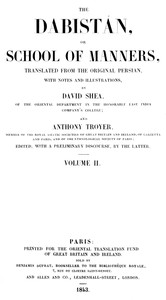
The volume's title page identifies it as a translation by David Shea and Anthony Troyer, published in 1843 for the Oriental Translation Fund. The translators' notes and illustrations frame the Persian original as a source of information on Iranian and Indian religions. The catalog subjects—Religions and Iran—Religion—are only partially reflected in the excerpts. The text does not focus on Iran but on India, and the author's Persian origin is mentioned only in passing. The excerpts show a work that is less a systematic theology than a descriptive compendium of beliefs and practices, often with anecdotal illustrations.
Hindu Systems: A Taxonomy of Sects
The second chapter is structured as a taxonomy of Hindu religious systems, each section devoted to a different school: the Smártís (legalists), Vedantins, Sankhya followers, Jogís, Saktíán, Vishnu worshippers, Chárvákián (materialists), Tárkikán (theologians), Buddhists, and various other Indian systems. The author distinguishes between orthodox Hindus and philosophers, noting that the Vedantins are the Súfís of this sect. The descriptions are brief and schematic, with little elaboration on doctrines or practices. The text treats these systems as objects of curiosity rather than as living traditions, reflecting the author's outsider perspective.
Guru Nanak and the Sikh Tradition
The excerpts include a lengthy account of Guru Nanak, presenting him as a teacher whose poems are "perfumed with devotion and wisdom." The narrative recounts a miracle: a woman falsely accused of infidelity opens a locked gate by her hand, proving her chastity. The text also describes the succession of Gurus after Nanak—Angad, Amaradas, Ráma-das, and Arjunmal—and notes the Sikh belief that Nanak's spirit transmigrates into each successor. The author reports that Nanak's disciples are not conversant with Sanskrit, and that his poems are in the Jat dialect of the Punjab. The account is sympathetic but distanced, emphasizing the Sikhs' reverence for Nanak as a divine figure.
Readers should note that this volume is a translation of a Persian work from the 17th century, and its descriptions reflect the author's own cultural and religious assumptions. The excerpts provide a window into how a Persian scholar categorized and narrated Indian religious traditions, but they do not represent authoritative accounts from within those traditions. The text is best approached as a historical document of cross-cultural encounter rather than as a systematic theological treatise.