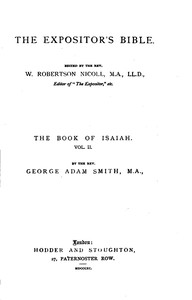
The Expositor's Bible: The Book of Isaiah, Volume 2 (of 2)
Edition facts
George Adam Smith's second volume on Isaiah opens with a detailed historical sketch before turning to the text of chapters 40–66. The commentary is notable for its attention to the prophet's changing rhetorical strategies: from the herald voices of comfort in chapter 40 to the sharp legal arguments of chapters 41–48. Smith frequently pauses to note shifts in pace, such as the sudden brevity of oracles or the expansion of a metaphor across several verses. He also draws analogies to modern figures like Mazzini to illuminate the prophet's conception of a faithful remnant. The result is a reading that foregrounds the literary craft of the biblical writer while remaining anchored in late 19th-century critical scholarship.
The Prophet's Rhetorical Cadence
Smith is alert to how the prophet varies his pace for effect. In the prologue (Isaiah 40:1–11), he identifies four distinct 'herald voices,' each with a different rhythm and urgency. The first voice is measured and comforting; the second, a cry in the wilderness, is abrupt; the third, about the fragility of flesh, slows to a reflective tempo; the fourth, announcing the shepherd, rises to a lyrical close. Smith notes that this alternation of short, staccato lines with longer, flowing passages is a deliberate device to engage the listener. Later, in the Cyrus oracles (chapters 44–45), the pace quickens as the prophet piles up divine titles and promises, creating a sense of momentum. Smith's commentary often points out where a sudden change in verse length or repetition signals a shift in mood or argument.
Voice and the Shifting Identity of the Servant
A central concern in Smith's analysis is the fluidity of the term 'Servant of Jehovah.' He observes that in the earlier chapters (40–48), the servant is identified with the collective nation of Israel, spoken of in the passive voice as the object of God's call. But as the prophet moves into the more active mission passages, the servant 'shrinks to something less than the living generation' and becomes a loyal kernel within Israel. Smith traces this through the prophet's own language: when the people are being addressed as recipients of deliverance, the voice is broad and inclusive; when they are being commissioned for a task, the voice narrows and becomes more demanding. This shift in address, Smith argues, reflects a real historical process of differentiation within the exilic community.
Analogies and Historical Framing
Smith enriches his commentary with comparisons to modern nationalist movements, particularly the Italian Risorgimento. He likens the prophet's evolving view of Israel to Mazzini's experience: initially envisioning the whole Italian people as ready for redemption, Mazzini found that only a handful responded. Similarly, Smith writes, the prophet learned that 'the many are called, but the few chosen.' These analogies are not mere decoration; they serve to illustrate the psychological and rhetorical pressures that shaped the biblical text. Smith also provides a substantial historical introduction covering the period from Isaiah to the fall of Jerusalem, grounding the reader in the political and religious context that produced these prophecies. This framing helps explain why the prophet's voice shifts from judgment to consolation to commission as the historical situation changes.
Readers approaching this volume will benefit from attending to Smith's own prose style, which mirrors the prophet's variety: at times dense with historical detail, at others sweeping in theological reflection. The commentary rewards those who read it alongside the biblical text, noting where Smith's observations about pace and voice illuminate the original. It is a work of careful scholarship that never loses sight of the literary artistry of the prophecies it explicates.