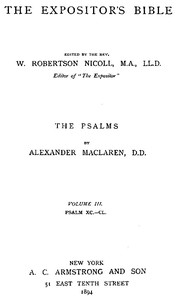
The Expositor's Bible: The Psalms, Vol. 3 Psalms XC.-CL.
Edition facts
Alexander Maclaren's third volume of The Expositor's Bible: The Psalms covers Psalms XC. through CL., offering verse-by-verse exposition grounded in the Hebrew text. The commentary consistently attends to poetic structure, liturgical context, and theological meaning, as seen in the extended treatment of Psalm 118. Maclaren presents the psalm as 'unmistakably a psalm for use in the Temple worship' and likely antiphonal, noting its probable association with the Restoration period after the Babylonian exile.
Antiphonal Structure and Liturgical Setting
Maclaren devotes careful attention to the performance context of Psalm 118, arguing that it 'falls into two halves' (vv. 1–16 and 17–29) and was probably sung as a processional hymn approaching the sanctuary, with parts assigned to a chorus of priests and the entering procession. He observes that 'every reader recognises traces of antiphonal singing' but acknowledges the difficulty of separating the parts with certainty. The commentary cites later Jewish tradition, where verse 25 ('O, I beseech Thee, Jehovah, save') became the festal cry at the Feast of Tabernacles, and notes that the seventh day was called the 'Great Hosanna.' This attention to ritual use distinguishes Maclaren's approach from purely literary or doctrinal readings.
Dating Debates and Historical Anchors
Maclaren surveys competing scholarly opinions on the date of Psalm 118, weighing the evidence for the Restoration period against proposals for the Maccabean era. He reports that Delitzsch fixed on the dedication of the Temple, while a more probable view connects the psalm to the Feast of Tabernacles celebration in Nehemiah 8. The commentary notes that Baethgen 'speaks with unwonted decisiveness' in dating it to 444 B.C., whereas Cheyne pointed to Judas Maccabaeus as 'the terrible hero' behind the refrain 'In the name of Jehovah I will cut them down.' Maclaren himself remains cautious, observing that the allusions 'are quite as appropriate to any other times of national jubilation and yet of danger.' This measured handling of historical evidence reflects the volume's scholarly tone.
Poetic Imagery and Theological Emphasis
Maclaren's exposition highlights the vivid imagery of Psalm 118, such as enemies 'beset me round about like bees' and being 'extinguished like a thorn fire.' He draws attention to the repeated refrain 'The right hand of Jehovah does prowess,' which appears three times in verses 15–16, and to the striking metaphor of the rejected stone becoming 'the head stone of the corner' (v. 22). The commentary treats these as expressions of trust in divine deliverance rather than mere poetic flourish. Maclaren also notes the psalm's movement from individual lament to communal thanksgiving, culminating in the call to 'leap for joy and be glad' on the day made by Jehovah. His analysis consistently ties the language to the worship setting he posits.
Textual and Translation Choices
Throughout the volume, Maclaren provides his own translation of each psalm, with careful attention to Hebrew phrasing. In Psalm 118, for instance, he renders verse 15 as 'The sound of shrill shouts of joy and salvation is [heard] in the tents of the righteous,' preserving the onomatopoeic quality of the original. He also notes textual variants and interpretive cruxes, such as the meaning of 'bough-bearing procession' in verse 27. These details reveal a commentator who is as concerned with philological precision as with theological exposition, making the work useful for readers seeking a linguistically informed guide to the Psalter.
Maclaren's third volume rewards readers who approach it as a work of historical-critical commentary rather than devotional literature. The sustained attention to liturgical structure, scholarly debate, and Hebrew phrasing makes it a valuable resource for students of the Psalms, particularly those interested in the intersection of worship and textual interpretation. The commentary's restraint in claiming certainty about dates or settings invites the reader to weigh the evidence alongside Maclaren.