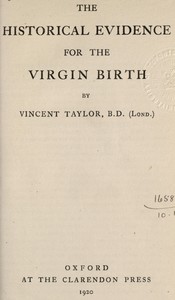
The Historical Evidence for the Virgin Birth
Edition facts
Vincent Taylor's 1920 study opens with a clear methodological statement: the book is 'a literary and critical examination of the historical evidence for the Virgin Birth,' not an advocate's brief. Taylor aims 'to trace and to define the earliest Christian tradition upon the subject, and to show the limits and the bearings of the historical question.' This self-limiting approach shapes every chapter, as Taylor weighs textual variants, linguistic features, and source-critical theories rather than theological claims. The work is organized around the two Gospel accounts—Matthew and Luke—with careful attention to passages often cited as inconsistent with the Virgin Birth tradition, such as the Lukan genealogy and the 'Western Text' of Luke 3:22.
Taylor's Critical Method and the Question of Advocacy
Taylor explicitly distances himself from advocacy, stating his aim is not 'obtaining an uncompromising verdict.' Instead, he seeks to define the earliest tradition. This methodological restraint is evident in his treatment of Luke 1:34–35, which he examines as a possible later insertion. He does not dismiss the passage but weighs linguistic and stylistic evidence, noting that 'the possibility of interpolation by an original author has often been overlooked.' Taylor argues that critics too readily assume original writers wrote 'with logical and almost unerring precision,' a view he links to lingering doctrines of verbal inspiration. His approach is to treat the Gospel writers as ordinary authors subject to revision, correction, and the incorporation of new information.
The Lukan Narrative and the Hypothesis of Authorial Revision
Taylor devotes considerable attention to the Third Gospel, arguing that Luke likely re-edited his work. He cites a modern parallel: Jane Austen's Northanger Abbey, first composed in 1798 but containing an allusion to a novel published in 1801, proving revision. Taylor suggests that 'the high art which is self-evident in a modern writer like Robert Louis Stevenson was not attained without corrections, substitutions, redrafting, and rewriting,' and he credits similar processes to St. Luke. He points to Luke's treatment of Mark's Gospel as evidence: modifications are 'stylistic,' intended to 'clear up difficulties,' or likely 'corrections introduced as the result of new information.' Taylor finds it 'inconceivable' that Luke would refrain from altering his own narrative if occasion arose.
Linguistic and Textual Scrutiny of Key Passages
Taylor's examination of Luke 1:34–35 includes a linguistic and stylistic analysis, though the excerpts do not reproduce his detailed arguments. He also considers the textual problem of Matthew 1:16, which receives an appendix. Throughout, Taylor engages with alternative theories, such as the possibility that the Virgin Birth narratives were later insertions. He does not dismiss these theories out of hand but subjects them to the same critical scrutiny as traditional views. His discussion of the 'Western Text' of Luke 3:22 shows attention to manuscript variants. Taylor's method is consistently to present evidence and then assess its weight, rather than to argue for a predetermined conclusion.
The Broader Historical Question and Its Limits
In the final chapter, Taylor addresses 'The Historical Question: Its Limits and Bearings.' He considers the date of the Gospels in relation to the Virgin Birth tradition, the historical value of the Gospels, and alternative theories. He also touches on 'Doctrinal Considerations,' though the excerpts do not reveal his conclusions. Taylor's preface emphasizes that the book is not a comprehensive defense but a limited inquiry into the earliest tradition. He acknowledges that 'a limited aim' characterizes the work, and he does not claim to resolve all historical questions. The book remains a model of critical restraint, focusing on what can be known from the textual and literary evidence.
Taylor's study rewards readers interested in the intersection of textual criticism, source analysis, and Gospel composition. His willingness to treat the Evangelists as authors who revised their work—citing parallels from Jane Austen and Robert Louis Stevenson—offers a refreshingly literary perspective on a often dogmatically charged topic. The book does not provide final answers but equips readers to weigh the evidence for themselves, making it a valuable resource for students of New Testament criticism.