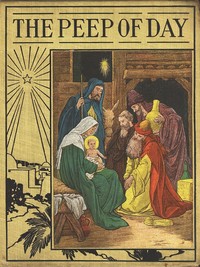
The Peep of Day
Edition facts
Mortimer's preface announces her ambition to be "the least of all" books, comparing her work to a hummingbird among birds. She targets children as young as three, promising systematic instruction after casual maternal teaching. The first lesson, "Of the Body," opens with a direct question: "You have seen the sun in the sky. Who put the sun in the sky?—God." This pattern of simple declarative statements followed by a question and answer recurs throughout, establishing a catechistic rhythm that assumes a child's capacity to grasp the invisible and eternal.
A Catechism for the Nursery
The book's structure is built around 52 lessons, each titled with a biblical episode or doctrinal topic. Early lessons cover the body, mother's care, the soul, and angels before moving into Old Testament stories (Adam and Eve, the first sin) and then a detailed life of Christ from the Annunciation through the Ascension, concluding with Peter in prison, John, and the Judgment Day. The lessons are short, typically two to four pages, and each ends with a verse or a child's prayer. The preface explicitly states that the work aims to be "the least watch ever made—the least picture ever painted—the tiniest flower that ever grew," emphasizing its deliberate simplicity.
Direct Address and the Child's Voice
Mortimer consistently addresses the child reader as "Dear Children" and uses a conversational tone. Questions are posed and immediately answered, often with a single word or short phrase. For example, in Lesson I: "Can you reach up so high?—No." This technique models the expected response, training the child in correct answers. The later excerpts include a poem spoken by the child: "Sometimes I think I never will offend, / By doing wrong, my best, my heav'nly Friend; / How soon my heart forgets! To God I'll pray / For grace to keep me in his holy way." This gives the child a voice of repentance and resolution, reinforcing the lesson's moral.
The Passion Narrative as Central Drama
Nearly a third of the lessons (Lessons 31–49) focus on the last week of Christ's life, from Judas's betrayal through the resurrection and ascension. The excerpts show Mortimer's method of retelling Gospel stories with vivid, concrete details: Jesus "fell upon the ground" in Gethsemane, "the blood came out of his skin, and fell on the ground," and an angel came to comfort him. She explains the cock crow as a morning event. The narrative maintains a child-appropriate tone while including the agony and betrayal, always concluding with divine comfort or a moral application. The lesson on the garden ends with Jesus' arrest, but the sequence continues through the cross and resurrection.
Poetry and Prayer as Pedagogical Tools
Several lessons incorporate short poems that summarize the episode or provide a child's response. In the Last Supper lesson, a poem recounts Jesus' words: "'This is my flesh,' the sorrowing Saviour said, / And, as he spoke, he gave the broken bread." The poem then shifts to Peter's denial and the disciples' flight, ending with the child's prayer for grace. These verses serve as mnemonic devices and emotional anchors. The book also includes prayers and hymns, such as the child's lines after the garden scene. Mortimer uses these to transition from narrative to personal application, teaching the child to internalize the story's lessons.
Mortimer's method rewards a sequential reading: each lesson builds on the previous one, from creation to judgment. Readers should note the careful scaffolding of concepts—starting with the physical body, then the soul, then angels, then biblical history. The catechistic format invites participation; reading aloud with a child, pausing for the expected answers, mirrors the original domestic setting. The later lessons on the passion and resurrection form the emotional and theological climax, and the poems offer a natural point for reflection.