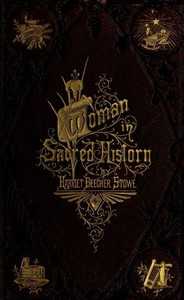
Woman in Sacred History A Series of Sketches Drawn from Scriptural, Historical, and Legendary Sources
Edition facts
Harriet Beecher Stowe's Woman in Sacred History opens with a striking editorial apparatus: the illustrations are selected from multiple artists and schools to avoid a 'conventional presentation' of biblical women. This curatorial choice signals Stowe's method throughout—she treats her subjects not as fixed icons but as figures refracted through scripture, history, and legend. The volume's structure, moving from 'Women of the Patriarchal Ages' through the 'National Period' to the 'Christian Era,' imposes a developmental arc on sacred history itself.
The excerpts reveal a writer who reads biblical narratives with a novelist's eye for psychological and social detail. In her treatment of Ruth, Stowe lingers on the 'sacred simplicity' of the barley-field scene, noting the 'religious spirit' that pervades Boaz's household. Yet she also offers pointed moral commentary: Naomi's affliction, Stowe argues, was 'needful' to prevent her family from settling among Moabites—a judgment that reveals Stowe's own theological framework.
Stowe's Moral Calculus
Stowe does not simply retell biblical stories; she evaluates the spiritual states of her characters. In the Naomi episode, she diagnoses a 'common phase of a low order of religion'—Naomi accepts divine affliction without self-examination. Stowe explicitly links this to contemporary readers: 'There are many nowadays to whom just such afflictions are as needful, and to whom they seem as bitter and inexplicable.' The authorial voice is that of a preacher drawing lessons from ancient texts.
This moralizing tendency coexists with a sensitivity to social dynamics. Stowe notes that gleaning was 'one of the allotted privileges of the poor' under Mosaic law, and she praises the system that 'consideration for the poor was interwoven with all the acts of common life.' Her analysis thus oscillates between spiritual diagnosis and social commentary, a dual lens that shapes her portraits.
The Art of Contrast: Sarah and Hagar, Leah and Rachel
The table of contents pairs figures in implicit dialogue: 'Sarah the Princess' with 'Hagar the Slave,' 'Leah and Rachel' as a joint entry. This structuring suggests Stowe's interest in relational tensions. The excerpts do not include these chapters, but the pattern is clear from the outline. Similarly, 'Delilah the Destroyer' stands opposite 'Deborah the Prophetess,' and 'The Daughter of Herodias' appears alongside 'Mary the Mother of Jesus.'
Stowe's method is comparative, not merely biographical. She uses the juxtaposition to highlight how women's agency is constrained or expressed within patriarchal structures. The inclusion of legendary material—such as 'The Mythical Madonna'—further complicates the historical frame, acknowledging that these figures have been shaped by tradition as much as by scripture.
Voice and Audience in the Ruth Narrative
The extended excerpt on Ruth reveals Stowe's narrative technique. She quotes dialogue at length—Naomi's lament, Boaz's greeting to the reapers, Ruth's humble question—and then glosses each exchange with interpretive commentary. The effect is a hybrid of sermon and literary analysis. Stowe emphasizes the 'delicacy' of Boaz's protection: 'Let her glean even among the sheaves, and reproach her not.'
She also attends to the physical details of the scene: 'parched corn and sour wine,' the 'noontide rest and repast.' These sensory touches ground the moral lesson in a vivid, almost novelistic setting. Stowe's audience, familiar with the biblical text, is invited to see it anew through her empathetic yet evaluative gaze.
Readers approaching Woman in Sacred History should attend to the interplay between Stowe's devout framework and her critical instincts. She treats biblical women as both exemplars and subjects of historical circumstance, often drawing parallels to her own era. The volume rewards those who read with an eye for its rhetorical strategies—the pairing of figures, the moral judgments, the careful selection of illustrative art—as much as for its scriptural content.